Tag Archives: efl

Networking

speaker

Image courtesy of Official GDC

Over the past weekend, I had the privilege of giving a session at the BC TEAL Lower Mainland Regional Conference in Vancouver, BC. I had a great time reconnecting with friends and colleagues, even if I was exhausted from my delated flight adventure involving long layovers in Toronto and Calgary and only four hours sleep.

The focus of my presentation was on creating a collaborative self-access library which included a bit of hands on practice with the things introduced. This is the same topic I gave at the TESL Ontario 2013 Conference in October with a number of changes made based on feedback given and my own thoughts about what went well and what didn’t. While it did go much better this time, there are still some things I would change if I do this presentation again.

Over the years, and even as recent as a couple of weeks ago, I have heard people complain about people who go to different conferences to give the same presentations to pad their resumes and build their ‘fame’ as an ELT professional. I understand this concern, but I feel that is a very shallow, narrow view of why people give conference sessions. Continue reading Networking

Watching

Screen Shot 2013-11-25 at 12.02.12 PM

Image still from the movie Entre les murs

This weekend, I made the exceedingly long journey to Vancouver for the BC TEAL Lower Mainland Regional Conference. I had a great time and I will certainly blog about that soon, but that isn’t the purpose of my post today. On the plane back from the conference, I watched the movie Entre les murs, an intriguing movie about a teacher and his middle school class in Paris. Even though I am not a K-12 teacher, I found it to be a fascinating and quite convincingly realistic voyage through a typical school year. I think the thing that caught my attention the most was that I felt like it wasn’t contrived, a  compelling story without the need of a storyline. Unlike many of films on schools put out by Hollywood, this story didn’t have a hero or villain, blatant agenda or mountain top experience. Instead, this story left me with more questions than answers. In the end, I didn’t find myself really liking or detesting either the teacher or the students. I felt a variety of emotions throughout the film, but none stayed consistent. Instead, it got me thinking about my classroom, my approaches to teaching and how I can learn from this situation. Here are my somewhat scattered thoughts: Continue reading Watching

Pitching

elevator

Image courtesy of Sean Benham
On a side note: This is my 50th post on this blog. As most of you know, I don’t get too excited about things like this, but it is nice to look back over the six months I have been working on this blog and see what has transpired since then. No matter how many visitors, retweets, FB shares, and so on that I get, I am in awe that anyone would think I have anything even remotely interesting to share. Thank you for putting up with my rants and incoherent rambling. I appreciate you all. Really.

Today I did elevator pitches with my students and I thought they did a really great job. I decided to do those instead of a traditional presentation for a number of reasons, but mostly because I feel it is more realistic than a lecture style speech. For those who are not aware of what an elevator pitch is, here is the basic situation.

Imagine you have walked into an elevator and standing there is the CEO / President / Manager of the company you would like to work for or with which you would like to do business. As the doors close, you have one minute to pitch yourself or your idea before the doors open again and you lose your opportunity of a lifetime. Continue reading Pitching

Tutoring

P1040148

Image courtesy of Rob Cabellero

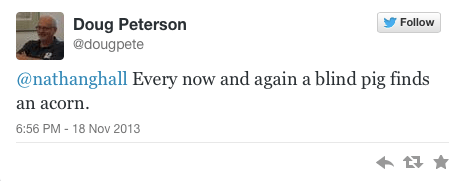
I am a terrible photographer. Really. For many years, I worked in the photographic industry as a sales person and trainer, but what I knew in my head about how a great image comes together never developed when it came time to push the shutter button. It still frustrates me. Sure, there are times I get a decent picture, but as the wise Doug Peterson once told me,

Screen Shot 2013-11-19 at 6.31.44 PM

It goes the same for writing. Continue reading Tutoring

Punishing

book

Image courtesy of florian b.

I’ve waited a while before writing this post in order to protect the person who I am writing about. I don’t want anyone trying to guess who it was who did this. The point of this post is to make all of us think about what we do when we choose reading or listening material for our students.

One day, when I was having lunch, a fellow teacher was showing me a text that she planned on using with her class that afternoon. As I looked at the text, I wondered about the difficulty level and asked her if the students were going to be able to handle it. She exclaimed, “I know it is too difficult for them, but the students have been mentioning that the texts I have been giving them were too easy and they were finishing too quickly. I am doing this to put them in their place.” Continue reading Punishing

Reflecting

why

Image courtesy of Katie Sayer

A little over a year ago, I went to a medical clinic in the city I was living in at the time as a follow up to a test that I had done six months earlier at the hospital. The situation was pretty routine in my mind. Go to the clinic, get the doctor to request a test, get the test done, and review the results together. The problem was that I had only been the in city for a short while and I didn’t have family doctor as of yet. That is why I was sitting in a walk-in clinic on a Sunday afternoon waiting approximately three hours to just get the call to go to one of the rooms where I could wait another 30 minutes for the doctor.

So, here I was sitting in the room, waiting (im)patiently. Looking around the room, I started to notice something strange. There wasn’t a single piece of current medical equipment to be found. The baby scale was a balance with a set of weights. There wasn’t a computer or screen around, only binders and clipboards. I started to wonder who was going to step through that door next. Then, with some struggle with the door first, entered the oldest doctor I had seen in a long while. He shuffled (literally) over to the nearest chair and plopped down. He took a moment to catch his breath while I looked on with a stunned expression. He lifted his glasses and pulled my chart within a nose length of his eyes and scanned the page. We talked for a bit about what I needed and he rose to open the door and bellowed to the nurse to bring him a form.

Supplied with the form, the doctor started to work his way down the paper. It went something like this:

“Do you have any allergies?”

“No.”

“Are you on any prescription medication?”

“No.”

“Are you pregnant?”

“Uhhhhh. Not to my knowledge.”

I have to say, that is the first time in my life that anyone, let alone a doctor, has asked me, a man, if I was pregnant. What was more surprising is that he didn’t miss a beat and continued his way down the form as if nothing was out of the ordinary. Needless to say, I was happy to get out of there, get the test done, and not have to return to the office since they found nothing wrong.

This situation is not unlike what I see with in the teaching field today. Continue reading Reflecting

Remembering

remembrance

Image courtesy of Mark Teasdale

For many of the British Commonwealth countries around the world, Remembrance Day is set aside for honouring those who have died fighting for their countries. One of the traditions around this holiday is the wearing of bright red plastic or cloth poppies, a ritual connected to the poem written by Lieutenant Colonel John McRae, a Canadian physician serving in Beligium in the First World War. Today, the Royal Canadian Legion in Canada sells poppies by donation, money that goes towards the veterans and their families.

As a child, I didn’t understand the importance of the poppy and I remember my friend and I bought up as many poppies as we could and put them on our jackets and shirts. To us, this was something that we could afford. We could put in five or ten cents in the bucket each time we saw someone selling them. We thought we were so cool, that was until one veteran saw us doing this and asked us what we were up to. We sheepishly explained that we were collecting them. He smiled and asked us if we knew what the poppy meant. Of course we didn’t, so he took the time to explain it in a gentle and thoughtful way. I remember us feeling pretty stupid afterward and gave him back all of our poppies, minus one each.

My problem was that I treated the poppy as a commodity, something to be bought, traded for, and displayed as a symbol of pride. What I hadn’t realized was how it was something completely different. Instead, the poppy is a symbol of unity and remembrance. A chance for us to show our support for others, whether rich or poor, common or famous, powerful or weak, we are all the same. It is about identity, a sign to others that we belong to this group, not standing up as individuals. The poppy itself is nothing more than plastic and metal, worthless material made valuable through the action of giving to others.

I don’t know why that came to mind today, but it started me thinking about how we treat assessment in the classroom. Continue reading Remembering

Dieting

scales

Image courtesy of davidd

When I was in grade eleven, I took a foods class as an elective. Most students took a language elective, but due to a long story involving a move from one part of Canada to another and a teacher who really hated me (I need to tell this story in more detail some time), I ended up dropping French in grade nine. So, here I was one of the only guys in a class of about 20 girls taking cooking and nutrition. Needless to say, it was a great choice. I actually learned a lot from that class including a pretty solid understanding of nutrition and diet. At that time, the Rotation Diet and Scarsdale diet were in vogue as a way of losing weight and we took the time to talk about fad diets and the dangers behind them. What my teacher stressed was that there was no magic bullet to losing weight and staying healthy. Eating balanced meals and exercising regularly were probably the best thing you could do to being and staying healthy.

No, I am not changing professions to become a food economics teacher, but what I do what to address is the need to find that ‘lighting in a jar’ form of teaching that will make learning so much better for your students and so much easier for the instructor. Throughout the years, methods and approaches have come and gone with varied success, but what sustains learning is something altogether different. Continue reading Dieting

Timing

stopwatch

Image courtesy of William Warby

Today, I had the opportunity to give my first webinar. I’ve given presentations before, but this is the first one I have done online. Normally, I’m quite comfortable giving a session, even if I am a little nervous beforehand. Once I get talking, I normally get into a groove. That wasn’t the case today, I felt the pressure of all of the things that could potentially go wrong and to top it off, my talk was being followed up with a second seminar right after mine. For some reason, that time pressure really got to me. I kept watching the clock, making sure I was on task and on time.

This experience made me think about my students and the way we time things in our classrooms. Continue reading Timing

Representing

8403827929_a7a10b017f_b

Image used by permission from UrbaneWomenMag

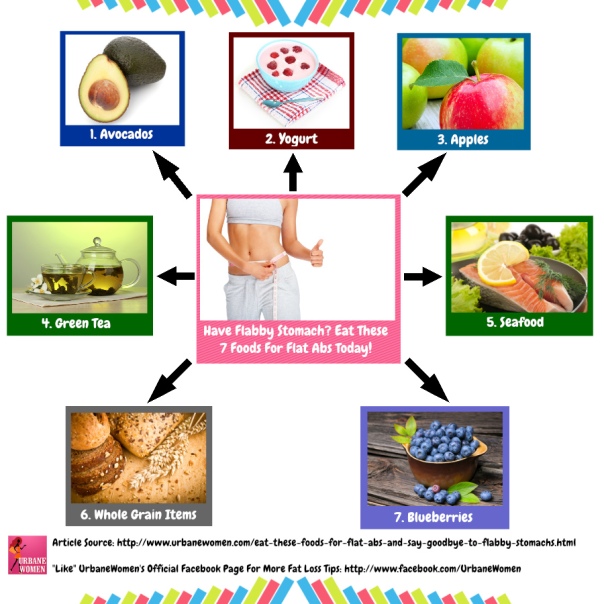
I don’t know when it started, but at some point in the last 5 or so years, people have really started to give up on fact checking. I mostly put the blame on the speed in which we receive our information. It used to be that we would read a newspaper or journal article, process it, discuss it, and then evaluate it on the merits of the content. Today, instead of newspapers, we have social media; instead of journal articles, we have infographics.

Ahhh, infographics. Those slick little data displaying, fun to share, fast-info representations of what used to be relevant data compressed into bite-sized chunks. Who cares where the material comes from, it looks AMAZING!

Of course I’m being a bit facetious and I have been known to use the odd infographic in my lesson, but I think I am pretty careful to weed out the visuals that blatantly misrepresent the truth. It isn’t always obvious, but with a little bit of sleuthing, anyone can separate the wheat from chafing (bad data use rubs me the wrong way). It was that very idea that started me on the journey to actually include MORE infographics in my classroom. Why not have the students critically analyze the data to see what has been carefully chosen, not added, or twisted in knots. Here is how I plan on going about this. Continue reading Representing