Flooding

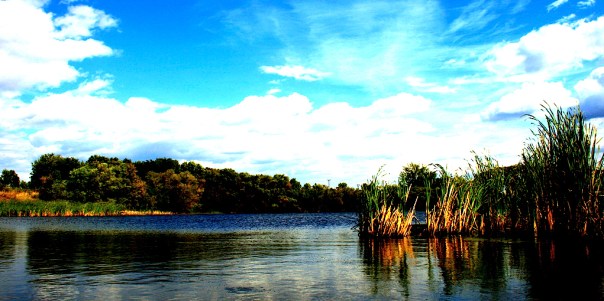
prairie wetland

Image courtesy of USFWSmidwest

It’s amazing what I can learn on my drive to work. This semester, I am working on two campuses which are about a thirty-minute drive from each other. During my daily commute, I listen to CBC Radio and I am always surprised how interesting some of these topics are. The other day they were interviewing a professor from the University of Saskatchewan regarding the flooding that was occurring in central Canada. He mentioned a study they had undertaken regarding the draining of prairie wetlands for farming and the effect this has had on spring and summer flooding. This study shows that this natural prairie watershed system was instrumental in dramatically reducing the flooding downstream. By allowing farmers to drain these small and seemingly insignificant ponds and marshes to provide more space for growing crops, water had no natural barrier and would eventually accumulate and overflow the natural banks, flooding farmland and municipalities downstream.

This got me thinking about teaching and how we are much like those individual farmers working on our small plots of land. Our actions, no matter how well intentioned, have an affect on our students and can cause problems further ‘downstream’. Continue reading Flooding


Starting

coffee cropped

Image courtesy of Cloud2013

One of my first jobs I ever had was working in a camera store in a shopping mall as a salesperson. Every morning, my boss would come in carrying a tray of coffee from McDonalds for everyone who was working that morning. One of the guys I worked with would smile, take the coffee, thank her, and then promptly put the coffee on the back counter. After a few weeks, I started to notice that he never actually took a drink from the cup, but the cup would eventually disappear. One morning, I watched to see what would happen. He grabbed the coffee as per usual and put the cup on the back counter. About an hour later, he took the cup with him to the photo lab and dumped the coffee down the sink. I asked him what he was doing and he simply said, “I don’t drink coffee.” He proceeded to tell me that he didn’t want to hurt our manager’s feelings, so he never told her. This went on the entire time I worked there and I suspect that it continued on long after I was gone.

For the manager, she thought she was being helpful and for the most part she was. I am sure all of us appreciated the gesture, but if she had taken the time to ask, she would have found out that most of us didn’t even like the coffee that much and would have appreciated something else instead. I am not trying to sound ungrateful, I am simply showing how a simple question could have made a difference in this situation instead of continuing to carry on in the way it had always been.

I have been spending a lot of time lately thinking about the things I do in class that I believe to be productive / helpful / important for learning a language. Continue reading Starting

Blaming

rsz_3202963823_4eb493c963_b

Image courtesy of Sudhamshu Hebbar

Back in 1986, my brother brought home a Howard Jones CD with the song No One is to Blame on it. We must have listened to that song over a hundred times over the span of that summer. Of course, I didn’t really understand that song since I was still pretty young at the time, but looking at the lyrics now, it isn’t that tough to grasp what was going on. Jones was attempting to wax poetic about the feelings of loss one feels when feelings are left unfulfilled.

While the ultimate meaning of the song does not really fit what I am writing about, I felt it was apt to start with that since nowadays there is plenty of blame to go around, especially when it comes to teaching and education. Our province in Canada is in the midst of a public teachers strike with plenty of finger pointing happening on both sides of the picket line. In other provinces, parents, teachers, and the government are waging a war of words regarding curriculum reform. The province I am in is fighting with the national government over funding for English language programs. Finally, teachers are fighting one another over what is happening in the classroom. You know what they all say? Someone is to blame. Continue reading Blaming

Fearing

pufferfish

Image courtesy of Saspotato

Social media can be so cruel. Before Twitter, Facebook and the like, I was content in thinking that I knew something. I felt like I was actually pretty knowledgeable and was able to connect the dots to apply that information in a meaningful way. But then I joined Twitter and started blogging. Now, I feel that I don’t really know that much really. When I read what others write and even the short snippets provided in Tweets, I feel, well, pretty dumb actually. I don’t say this to gain pity, I am admitting it because I am starting to realize that this is somewhat of a gift. Continue reading Fearing

Researching

Blood_letting

Image Public Domain

Imagine yourself living in the middle of the 17th century suffering from a migraine headache. What would you do? Go see a physician of course! What was the cure? Bloodletting was the standard response since the body was made up various humours and by draining some of the blood from the body, you were putting the various humours in balance (Ali Parapia, 2008). Fast-forward to today and this has been proven to be a rather dangerous practice as any substantial blood loss affects every cell in the body and can cause anaemia, tissue damage, organ failure, and ultimately death if not restored (Garrioch, 2004).

Since I am not a doctor, nor play one on TV, my knowledge of this subject is based entirely on what I have read from experts in the field. Where did they get their knowledge from? Continue reading Researching

Reading

5573381914_00a7bc2517_b

Image courtesy of Phil Roeder

This is the final instalment of my first #444ELT project. To find out more about the project and to read the other three posts, here they are:

In this final week, I explored the concept of extensive reading. I have used extensive reading in my classes in the past, so I wanted to find out what the research says on the topic. Here is what I found. Continue reading Reading

Collecting

portfolios

Image courtesy of Sean Winters

This is week two of my #444ELT personal challenge. Here is a link to week one.

This week I spent time digging through articles on the use of portfolios in the classroom. This is something I already do and have done for a while, but I wanted to see what others were doing and to see if there was anything I could do better. I learned a great deal this week and I may keep on reading about portfolios as I feel there is some real value to it beyond what I am doing at the moment.

I invite all comments, suggestions, and even criticisms. Share below in the comments section or on Twitter.

Continue reading Collecting

Helping

5096894782_0b422b2aa3_o

Image courtesy of the Minnesota Historical Society

The summer after I turned thirteen, my parents encouraged me to get a summer job. I had no idea how to get a job, so I wandered down to the local student summer employment office for some advice. During my meeting with the job counsellor, I was asked if I would be interested in working at the courthouse for a few days doing some landscaping. I was so excited. My first job! Of course I accepted, so she told me to report to the landscaping office at the courthouse the following morning. Being thirteen, I didn’t take any notes, so I completely forgot the name of the person I was supposed to meet at 8:00 AM. Oh well, I would figure it out.

I wasn’t much of a morning person at that time, but that morning I was up and ready to go. I was so proud to have a job and I looked forward to getting paid for my own work, not some errand I had done for someone I knew. I jumped on my bike and rode off to the courthouse in search of the mystery person I had already forgotten. Upon arriving at the back parking lot, I locked up my bike and headed into the first door I could find. After some wandering around some back hallways, someone in an office came out and asked me if I was Jason. “Nope, Nathan,” I replied. “I’m sure it is just a typo,” he mumbled as he ushered me into his office. “You’re smaller than I expected,” he chuckled. I didn’t laugh. Continue reading Helping

Building

words

Image courtesy of Taryn

A few days ago, I posted this ‘challenge’ on Twitter:

Project #444ELT: Helping ELT professionals connect with ELT research

  • Read 4 journal articles every week for 4 weeks (a total of 16 articles)
  • Each week, write a blog post that has:
    • a reference to each article
    • a short summary of each one
    • your remarks or thoughts on the content
    • a list of questions raised after reading each article.
  • Share your post on Twitter using the hashtag #444ELT
To be totally honest, I thought it might catch a few people, but instead the response via retweets and favourites has been really surprising. I mostly did this to keep myself accountable, but I was secretly hoping a few people might join in as well. It is a little different than a blog carnival in that the person joining in can do it at any time instead of setting a deadline. This is meant to be ongoing as a means to promote the use of ELT research in the classroom. By forcing yourself to participate in this short challenge, it is hoped that this will create a routine of sorts that will carry on throughout your career.

I decided to choose a theme for each week. This week’s theme revolves around vocabulary learning/acquisition and the use of intentional and incidental means. Each study is different in many ways, but the common thread shows amazing continuity in the results with some solid applications for the language classroom.

So, without further delay, here is my first entry: Week one of #444ELT Continue reading Building